Article
NATIVE'26: what 400 HR executives heard about HR as a product
A CHRO panel with Nubank, Uber and Stone, Zivo's view on the future of HR, and Marty Cagan on HR as a Product. Our recap of the event that gathered about 400 CHROs and HR executives in São Paulo. Available in Portuguese.
Published Sep 30, 2026
One thesis, three blocks
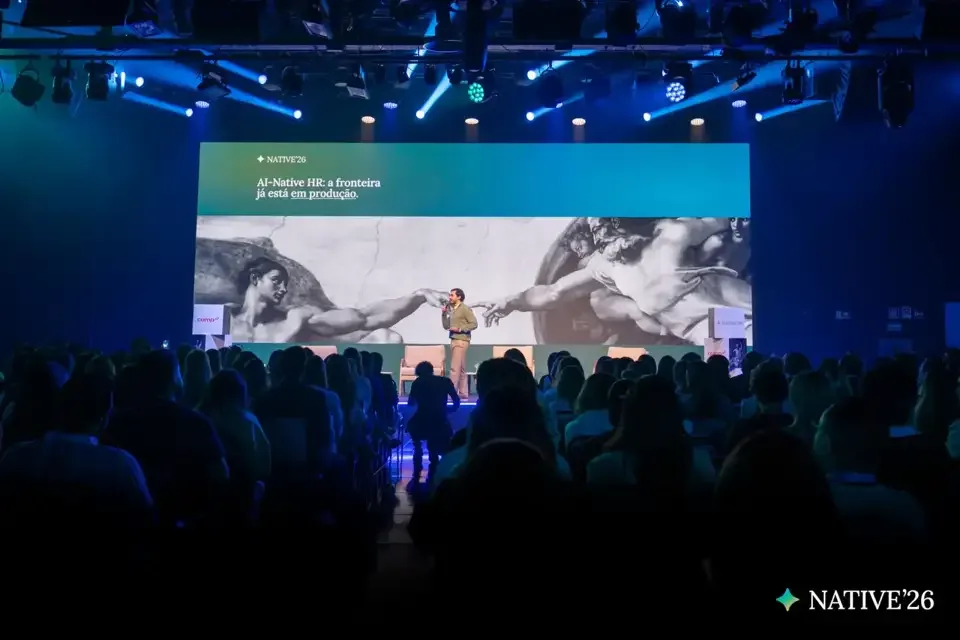
The evening opened with a panel of CHROs already running this model (Nubank, Uber and Stone), continued with Zivo's vision for the HR of the future, presented by Pedro Bobrow, and closed with Marty Cagan, author of Inspired, Empowered and Transformed, speaking to an HR audience about HR as a Product. Then dinner and happy hour.
The event's Renaissance visual identity has an explanation. As the master of ceremonies said at the opening, the bet is that we're in a new period of discovery, and that this time it's happening anywhere in the world, including São Paulo.
- ~400 CHROs and HR executives from Brazil's biggest companies.
- 3 Content blocks: CHRO panel, Zivo's vision and Marty Cagan.
- 1 Thesis: HR can operate as a product.
Panel: what's already in production at Nubank, Uber and Stone
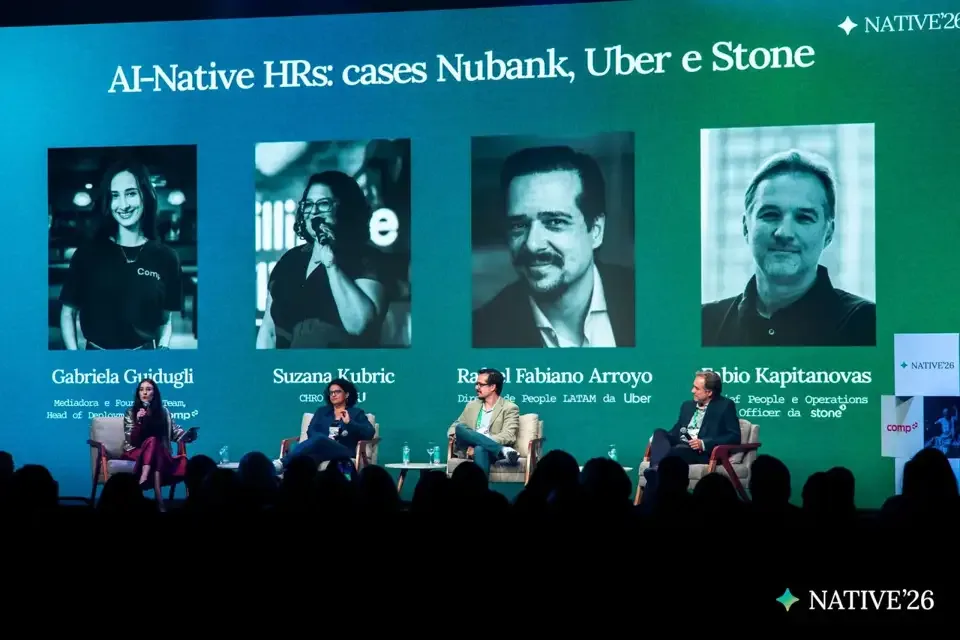
Gabriela Guidugli, from Zivo's founding team, moderated the panel with Suzana Kubric (CHRO at Nubank), Rafael Arroyo (People lead for Latin America at Uber, with nine years at Amazon before that) and Fabio Kapitanovas (Chief People & Operations Officer at Stone). The panel's rule was to talk less about what AI can do in the future and more about what has already changed in operations.
Nubank
20% of the HR team are PMs, designers and engineers.
Suzana Kubric · CHRO at Nubank
The project Suzana called P&C 3D started three years ago, before the generative AI wave. The diagnosis was that HR operated from the inside out, creating processes and policies and becoming the police of what people did. The answer was to import the business's own product management model: cross-functional squads, mapping the employee journey from first contact to exit, four pilots starting from real pain points, and a methodology of discovery, design and deploy. Each solution has a success metric, and the senior HR team reviews the portfolio every quarter to kill products that don't move the needle. A points-based recognition program on Slack was one of the casualties: in the areas where it ran, engagement with recognition fell instead of rising.
“We create processes, policies, and become the police of what people are doing. And it was really boring. We weren't happy doing that.”
Suzana Kubric
According to Suzana, having product and engineering people inside the team is what accelerated AI adoption when the technology arrived. The biggest pain today is reliable data inside HR.
Stone
The employee and the manager treated as customers.
Fabio Kapitanovas · Chief People & Operations Officer at Stone
Stone applied internally the same AI support solution it already used with customers. The tool, called Gentil, answers policy questions and HR and leadership questions, and the next frontier is using the same base for training, onboarding and simulating the impact of organizational changes. Fabio measures the HR team's efficiency by the ratio of people in HR to people in the organization, and says it has practically doubled in three years. Total cost, adding up people, software and tokens, fell over the period.
“Try to measure the HR team by the final business result and not by the metric itself.”
Fabio Kapitanovas
Two warnings from Fabio on metrics. The first is Goodhart's law: measuring changes behavior, and the team may start adapting the process instead of solving the problem. The second is measuring the right thing: eNPS, turnover and training hours can be going up with no impact on the business. His proposal is to measure HR by the company's bottom-line result.
Uber and Amazon
What went wrong teaches more.
Rafael Arroyo · People lead for Latin America at Uber
Rafael brought Amazon's practice of asking the organization daily, specific questions with AI support, instead of a semiannual engagement survey. The argument is that a snapshot from six months ago is no use for running today's Uber, which just went through a layoff. He also told of two failures. A resume screener fed by managers' repertoire started always delivering the same candidate profile, with the managers' biases built in, and had to be shut down. And one of the first employee support bots answered a grieving person asking for help with a link to the handbook. The tool was turned off that day.
“AI isn't just letting AI loose to do things for you, it's working with it and adjusting course, even blocking it, stopping it at that moment so it doesn't keep doing the wrong thing.”
Rafael Arroyo
Tips from those who have already started
Suzana recommends bringing technical expertise into the team, investing in data and platform infrastructure, and hiring a design consultancy, not an HR one, to map the employee journey. Fabio suggests picking one problem, allocating a squad, learning from it and only then expanding. Rafael points out that most Brazilian companies are still in the second wave: before choosing a tool and a prompt, you need to build repertoire, define a sponsor and a PM, and publicly recognize those who deliver AI projects.
“My answer is I don't know. I think everybody is racking their brains to solve this problem.”
Suzana Kubric, on how to measure AI ROI
On how to measure AI ROI, the most honest answer came from Suzana: “I don't know.” PRs per engineer and self-reported hours saved measure output, and are imperfect. She cited a conversation with OpenAI's CRO, who gave up on measuring productivity and started tracking revenue per employee. Rafael said Amazon used cost and revenue per headcount, with the caveat that areas with different missions don't fit the same ratio.
The audience question that generated the most discussion was about the future of juniors. If AI takes over entry-level work, where will the seniors come from five years from now? Suzana sees a real problem: the human role is migrating to judgment and strategy, and nobody develops judgment without having done the work. Her bet is on mentoring and shadowing programs, and the discipline of continuing to approve investment in entry-level programs even when short-term pressure pushes toward going senior. Rafael framed the topic as a social movement, one that demands the same intentionality companies devoted to diversity.
“How do you train people to have judgment and strategy if they've never done the work?”
Suzana Kubric
Pedro Bobrow: why HR is not the most important area of the company
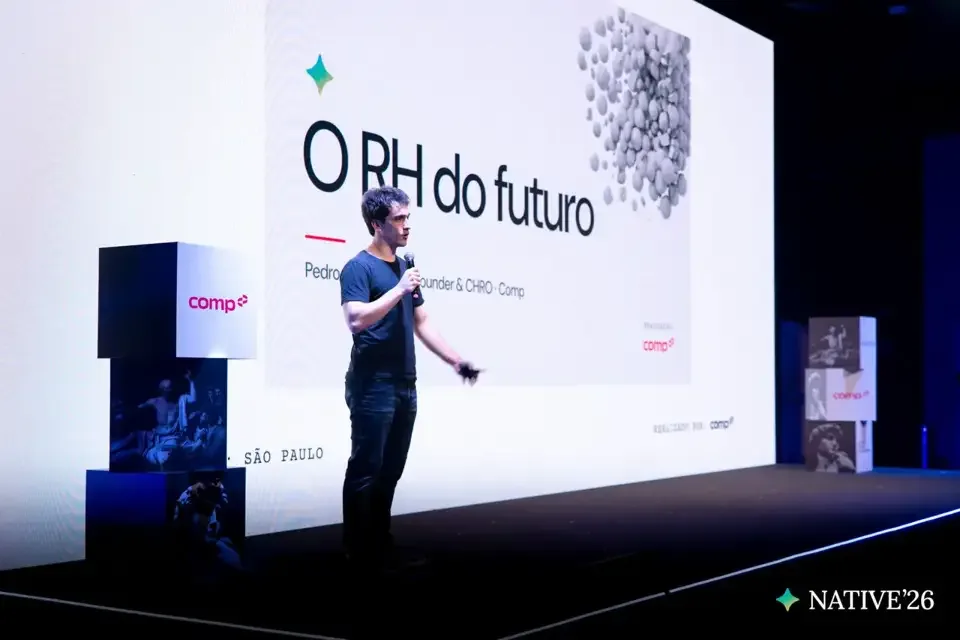
Pedro started with a contradiction everyone in the room recognizes. People are the most important asset of any company. HR is responsible for people. So HR should be the most important area in the company. In practice, payroll is one of the company's biggest investments and still isn't a board topic, and often HR isn't even in the room.
From the stage · the syllogism
- IF People = most important asset
- AND HR = responsible for people
- THEREFORE HR = most important area… right?
“People are the most important thing, but I'm not spending energy on it. Actually, not every company. Look at a company like OpenAI today, paying 6 billion dollars to buy an employee and his team. Not the technology, not the solution, a team.”
Pedro Bobrow
His explanation is about cognitive load. Important decisions should get proportional cognitive investment, the way an M&A does. People decisions don't. He gave three examples.
- A hiring process with four evaluation criteria and a performance cycle with five ratings at the same company, without anyone having decided why. Lack of cohesion across People policies.
- A continuous Zivo survey showing that 91% of hiring offers are made mainly based on the candidate's salary expectation, ignoring the salary table, the budget and how critical the role is. Exposes a lack of planning and criteria.
- HR operating as an order taker: the business asks for a mid-level engineer and HR hires a mid-level engineer, without asking whether the last two mid-level hires lasted more than two months. HR that is not a strategic partner in workforce planning.
“We stop thinking that the objective function is taking orders, and start thinking about making better people decisions. Who I hire, who I let go, who I promote, where I put these people, how I train and develop them.”
Pedro Bobrow
Zivo's thesis has three parts
Stop thinking of HR as a set of departments and think of it as an interconnected journey, in which offboarding feeds hiring and evaluation informs who to hire. Treat HR as a product, with an owner, a vision, a business problem to solve and a defined customer (employee, manager and company; never HR itself).
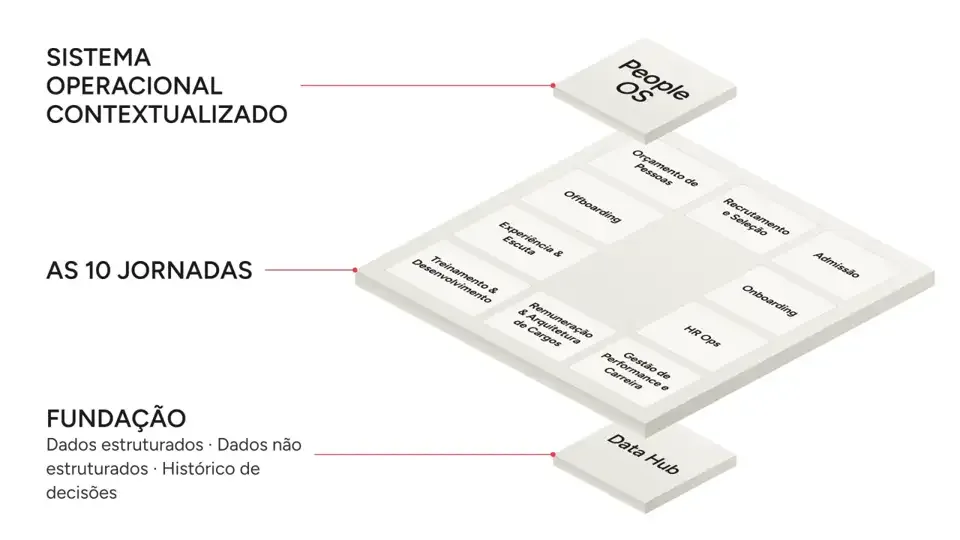
From the stage · the journey as an interconnected loop
- ATTRACT
- HIRE
- ONBOARD
- ENGAGE
- DEVELOP
- EVALUATE
- RECOGNIZE
- OFFBOARD
Not an assembly line, a loop: offboarding feeds hiring, evaluation informs who to hire, and each stage talks to the others.
From the stage · HR as a product
And, like any good product, it should have:
- Ideal Customer Profile: employee, manager and company
- Pain points: difficulty hiring, retaining and upskilling…
- KRs: adoption and business impact…
- Product vision: …
The example he ran on stage shows what changes. A salesperson closes an expansion deal and the agent collects feedback from the people who worked most with them, cross-references it with CRM and customer surveys, and continuously updates the person's profile, instead of waiting for the semiannual cycle. Aggregated by team, this lets HR do what almost no one does today: question whether the NPS target is realistic, show that the team is below the company average and lacks the necessary skills, point to two roles open for 90 days that no one accepts at the salary offered, and put together a workforce planning plan with internal moves, offboarding and compensation adjustments. Pedro cited cases already in production, including a five-percentage-point reduction in turnover without touching the budget, just by using data to change the decision on who receives merit.
From the stage · cases in production
- Metalworks Turnover cut from 8% to 3% in one year through smarter allocation of merit raises
- Tech Sales team ramp-up time at onboarding cut from 120 to 60 days
- Tech Org structure cut from 8 to 6 layers with stable payroll
The point he made a point of marking is that none of this depends on AI. The word didn't appear in the first half of the talk. What changes is intentionality in how HR operates, and that responsibility belongs to the CHRO.
“Notice that I haven't said the word AI once here. I'm not talking about artificial intelligence. I'm talking about thinking with intent and intentionality in how we operate.”
Pedro Bobrow
The question that closed the talk: looking at your journey end to end, what would you build differently today?
Marty Cagan: project model versus product model
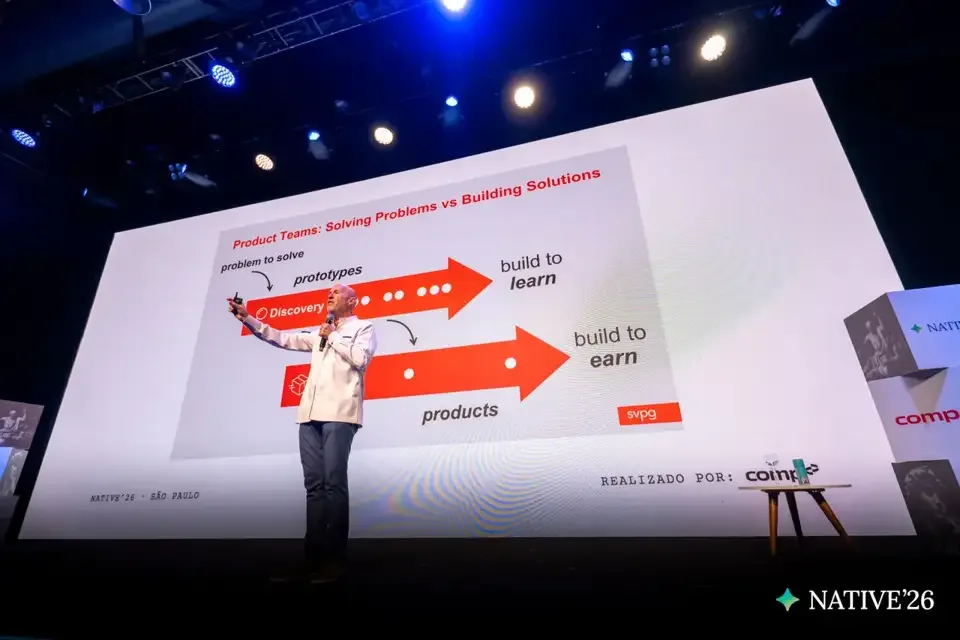
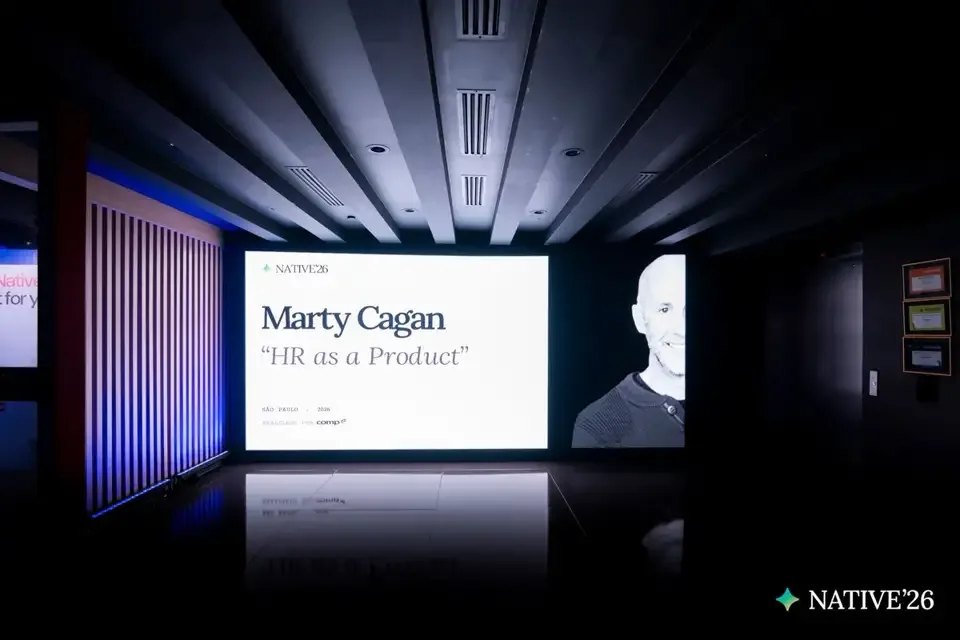
Marty has worked for 20 years with engineers, PMs and designers at Brazilian companies, and said the question that always comes up after a team learns to build product is whether the same can be done for the company's own employees. The talk was about how to do that the way the best companies do it.
Buy or build. Systems like an ATS have thousands of business rules and it almost always makes sense to buy. The problem with buying is that you're stuck with whatever the vendor decides to deliver. For what's worth building, there are two paths.
Mercenaries
The project model
It's the way practically every HR team already works, with or without a consultancy behind it: request, business case, roadmap, requirements, sprints, delivery. Marty cited a Harvard Business Review article estimating that about 85% of what gets built in this model doesn't generate the expected business result. The reasons are well known. It's very hard to know in advance which idea will work, internal tools rarely have a designer and therefore need training to be used, and the process is designed to blame someone when it doesn't work. The team owns nothing. He called them mercenaries.
“It's not Accenture's fault. It's your fault. It's very hard to know the solution that you need in advance.”
Marty Cagan
Empowered teams
The product model
It swaps a roadmap of features for problems to solve, with a measurable outcome. Instead of asking for ten features, HR says onboarding needs to drop to 30 minutes, and the team figures out the best way to get there, even if the answer is to build nothing. The five hard concepts, in his view: empowered teams, a product manager role that almost no company has (and that isn't solved by renaming product owners, the number one reason transformations fail), product designers, engineers as first-class members of the team, and swapping features for problems. The dynamic has two simultaneous fronts: discovery, in which you prototype and test with employees, managers, compliance and legal before building anything real, and delivery, in which engineers build what the company will run.
“It moves from mercenaries, which are there to build whatever you tell them, to missionaries, which are there to solve problems.”
Marty Cagan
What HR needs to give the team. Here Marty was direct: without three things, it's not even worth trying. Access to the users, that is, the employees. Access to the usage data those employees generate. And access to the HR leader themselves, several times a week, for 10 or 15 minutes, to validate prototypes against real constraints of compliance, privacy and law. In return, the team should bring knowledge of business viability, command of the enabling technology (the ones really innovating with AI today are engineers, not executives or PMs) and commitment to the outcome, not the date.
“If you can't answer the question yet, you're not ready to have anybody work on it.”
Marty Cagan, on defining the problem and the success metric
Predictability versus outcome. If you demand a date, the team delivers on the date by cutting everything that doesn't fit. Marty cited the Spotify poster, “100% predictability equals 0% innovation,” and said the legitimate exception is a law with a deadline, treated as a high-integrity commitment, which is expensive and rare. On the question about the HR calendar (payroll on the 5th, cycle in March, survey in May), the answer was to separate the two things: payroll having a fixed date doesn't mean the payroll improvement has to be ready on Tuesday.
“Teams know how to meet the date. They meet the date by cutting everything that doesn't actually deliver. And so that ships output, not outcomes.”
Marty Cagan
Vibe coding. He told the story of an HR person who prototyped a time-tracking app in a few days and gave up after a week, because every change broke the rest. The recommendation is to prototype freely, because it changes your own mind about the problem, without confusing a prototype with a product the company can run. A prototype is for learning. A product has to be reliable, performant and fault tolerant.
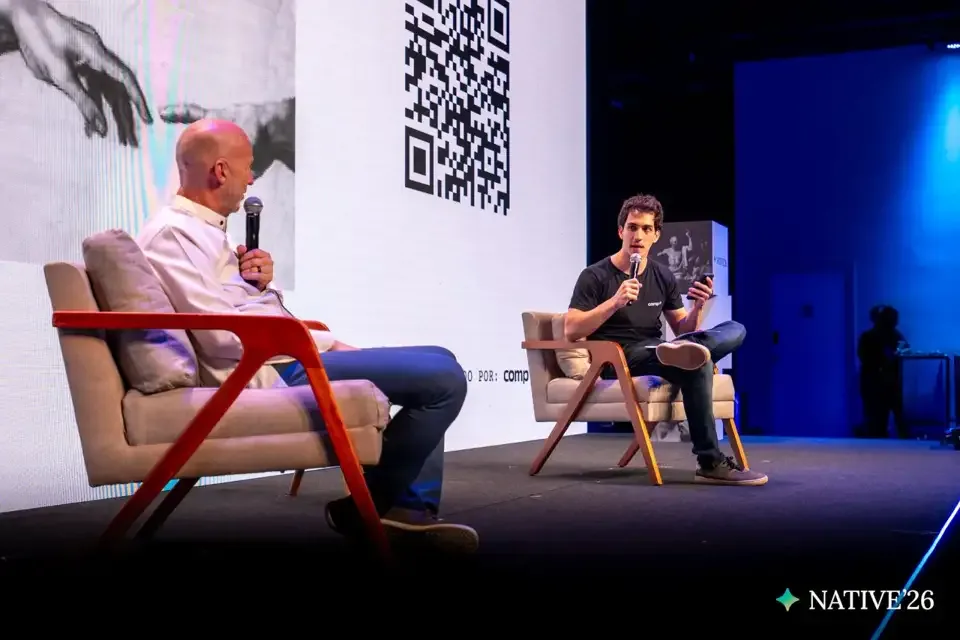
Where to start. His favorite question came in the Q&A with Pedro: what is the first step for an HR leader with limited resources. The answer was a single pilot. Pick one problem out of the ten you have and run it the way described, with everything changed for one team. Don't start with a training plan and new job descriptions, because you only know what you need after seeing it work. Small changes scattered around never show the CEO what the model should look like.
“Don't use the project model to try to move to the product model. Prototype it. Test it. Just on one.”
Marty Cagan, in the Q&A
On the wave of Chief AI Officers, his view is pragmatic: each function uses AI differently, and someone needs to look at the work job by job. Some tasks will be replaced. In most jobs, the task is automated, the thinking is not.
“In most jobs, the tasks might be automated, but the thinking is not.”
Marty Cagan
What stays with us from NATIVE'26
- Judgment and strategy was the most repeated phrase of the night. That's where the human role in HR is migrating, and it's what training programs need to develop.
- Start with the problem, with a metric. Fabio's answer on ROI (salesperson ramp from six to four months; what's it worth to get to two?) and Marty's product model are the same rule.
- Fall in love with the problem, not the solution. The recognition program killed at Nubank and Amazon's biased screening are the cost of doing the opposite.
- HR is not HR's customer. Pedro estimated that the department spends most of its time improving its own life instead of the lives of the employee, the manager and the company.
- One pilot, everything changed, one team. Three speakers arrived at the same recommendation for those who haven't started.
- Without reliable data, none of this works. It was the biggest pain cited by Nubank and the first layer of the architecture Zivo proposes.