Article
Org Design is not a project.
What the company needs vs. what it has. Every operational inefficiency lives in some version of that delta, and Org Design isn't a project you solve once.
 Lucas Dian
Published May 5, 2026
What the company needs vs. what it has.
This important equation can only be solved through organizational design. We are talking about capabilities, people, structure and size. Every operational inefficiency we diagnose in our clients lives in some version of this delta. And the faster the company grows and the faster the strategy changes, the wider that delta opens.
Δ operational inefficiency = what is needed − what is in place
So, throughout this text I will share details of how we are approaching and delivering Org Design and operational efficiency for our clients. Not as a deliverable in itself, but as a living system that fits this dynamic of growth and change.
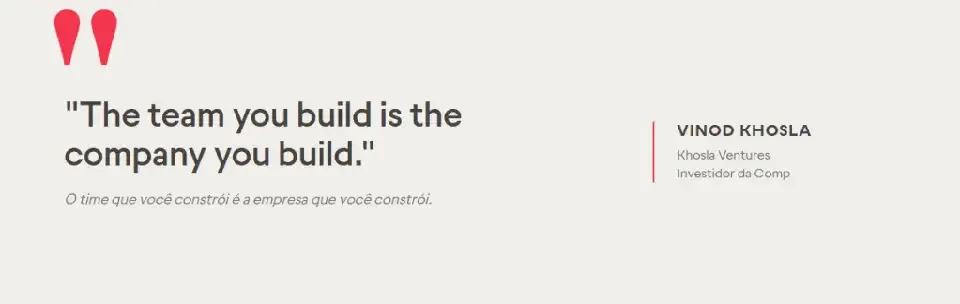
There is a line from Vinod Khosla, possibly the biggest AI investor in the world and a Zivo investor since the Series A, that he recently shared with his founders and that resonated here at Zivo: "the team you build is the company you build." What makes this line so powerful is the context. It comes from the person who bets the most on AI rewriting the economy. And even in that context, or precisely because of it, he insists that a company's most important asset is still the team it builds. As AI advances, this point becomes more important, not less: at a time when all human work is being transformed in cycles of months, the only sustainable competitive advantage is the speed with which you close the gap between what the company needs to be and what the team delivers today.
I spent half of my career in strategy consulting and the other half inside the "hard" areas of HR (Total Rewards, Analytics, Budgeting, Performance, etc.). One thing became clear to me along the way: organizational design rarely fails for lack of intent and goodwill. It fails for a more structural reason: the topic tends to be treated as a project with a beginning, a middle and an end. A scenario I have seen repeat countless times: the CEO hires a strategy consultancy, it delivers an eighty-slide diagnosis, the company implements forty percent of what was designed, and six months later the same problem comes back in a different outfit. What we have been refining as a thesis here at Zivo is exactly the opposite of that model.
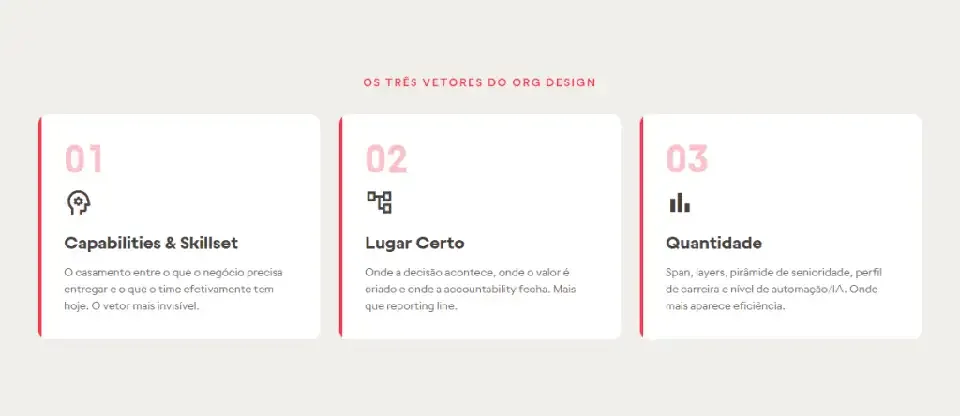
When I look at Khosla's line through the lens of someone who follows organizations from the inside, what I see are three vectors that, together, underpin how teams are built in companies. And they are almost never misaligned in isolation.
First vector: capabilities & skillset
The match between the core capabilities the business needs to deliver its strategy (what is "needed") and the skillset the team actually has today (what is "in place"). This is the most invisible vector and the one most often out of sync. The team that brought the company this far is not necessarily the one that will take it to the next stage; at least not without understanding how to amplify its know-how or multiply its productivity with AI. I have very rarely seen this diagnosis done with the depth it deserves.
Second vector: the right place
Let me define what I mean by "right place": the organizational design where the best profile meets the best environment to deliver results. Roles, responsibilities, interfaces, the bridge between structure and compensation (not only in terms of compensation strategy, but how the structure unfolds into architecture and careers and how job valuation determines the ideal number of layers). It is not just "who reports to whom." It is where the decision happens, where value is created and where accountability closes.
Third vector: quantity
Span of control (Span), hierarchical layers (Layers), seniority pyramid, career profile, level of automation/AI. This is where we have seen the biggest operational efficiency opportunities, whether at the base (bloated structures that get in the way of decisions, or structures too lean that stall execution) or at the top (Span or Layers that block decisions and accountability or that fail to drive results and value) of the pyramid. Or, now, of the corporate diamond.
The key point is that the pain we hear most often in conversations with C-levels, investors and boards is not the result of any one of these vectors alone. It comes from combining them with the speed of change companies are living through:
- Headcount grows thirty percent in the year;
- The strategy gets rewritten twice;
- AI starts to redesign what counts as human work in entire areas;
- And the organizational design stays frozen at the last leadership offsite, trying to adapt to a reality that has already changed.
It is in this mismatch that most of the operational inefficiency of Brazilian companies is hiding today. And it is at this mismatch that we have been looking most closely.
The approach we have been building at Zivo starts from a different premise than the one classic strategy consulting works from. "Org Design and operational efficiency," in our reading, is not a deliverable but a living system, which needs continuous diagnosis, joint modeling with the client's team, governance over time and clear efficiency metrics.
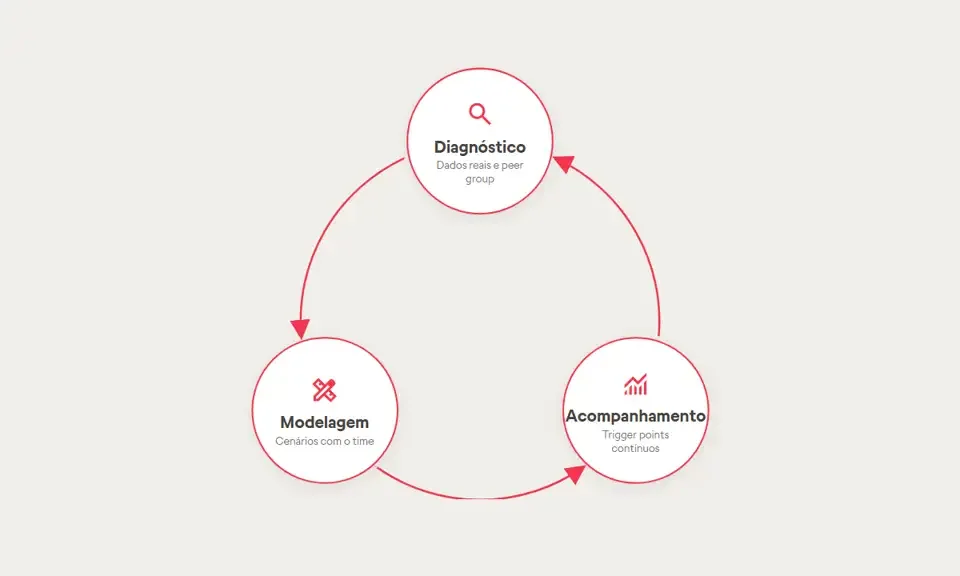
We start by diagnosing with real data, comparing span of control, hierarchical levels, seniority pyramid, golden ratios, underutilization positions, level of automation/AI, etc. All of it against a peer group and also against history (no guesswork). Then we model the scenarios together with the team. After all, whoever will execute needs to own the design, not just receive it ready-made. And then we enter the most important stage of the transformation: follow-up. We monitor organizational health, set the triggers for releasing capacity (trigger points), revisit the design as the strategy evolves, and connect Org Design with compensation cycles, workforce planning and the budget. This is what we call HR as a Service (HRaaS).
That is why our Org Design and operational efficiency thesis has lately moved out of the "span of control benchmark" territory (which is where most conversations on the topic start and end) and into a much broader one. Span is important, but it is one lens. Hierarchy levels, role design, accountability, the bridge between structure and compensation, workforce planning, and now the impact AI has on the very concept of work: this whole set is what we understand as Org Design and operational efficiency, and what we have operationalized and scaled with our clients in a continuous and intentional way. No eighty-slide PowerPoint solves this. It is solved with method, data, joint modeling and follow-up over time. In other words, with a superpowered HR teammate.
Org Design is not a consulting project. It is how you operate.
If "the team you build is the company you build," then designing the organization and closing the delta between what it needs and what it has, in capabilities, place and quantity, is not a consulting project. It is how you operate. And in an era when AI rewrites what counts as capability and skillset in cycles of months, this way of operating needs to be continuous, living and data-based.
Starting from this anchor article, I am announcing that I will be opening a series on the topic, going deeper into specific layers with the support of cases; whether telling a bit about our experience here at Zivo, or drawing a parallel between the most relevant articles in the world and our perspective and approach.
And if, in this article or the next ones, you identify a pain, need or opportunity inside your company, get in touch and see how Zivo can be your superpowered HR teammate, also for operational efficiency and Org Design.

Lucas Dian HR Executive, Zivo