
benchmark
How much do founders of VC-backed companies earn?
Introduction: We know that, for a founder, the art of setting your own salary can be a challenge, given the difficult balance between available cash and quality of life, especially in an environment marked by inflation and uncertainty about a possible recession.
Published Nov 14, 2022
Introduction: We know that, for a founder, the art of setting your own salary can be a challenge, given the difficult balance between available cash and quality of life, especially in an environment marked by inflation and uncertainty about a possible recession.
After hearing from many founders facing the question of how to pay themselves, Norte (a Venture Capital fund focused on pre-seed and seed, created by entrepreneurs) and Zivo joined forces to analyze the compensation of founders in Norte's portfolio. The material serves as a reference for early-stage founders and includes startups at different stages, in different sectors and with different business models.
That said, unlike setting compensation for nearly every other position in a company, we believe that founder compensation is more art than science. Beyond the variables in the analyses below (company stage, equity, age), many others affect founder compensation that we didn't collect, such as the founder's personal financial situation, the company's runway (how much cash it has divided by monthly burn) and much more. We want to offer this data to the market as a direction to follow, recognizing that every founder's situation has many nuances.
Part 1: How does company stage affect salary?
First, we looked at how a company's funding stage correlates with founder compensation. As we can see below, the later the company's stage, the more founders tend to pay themselves; however, the statistical correlation is only moderate (R2 of just 0.41 using the least squares regression method).
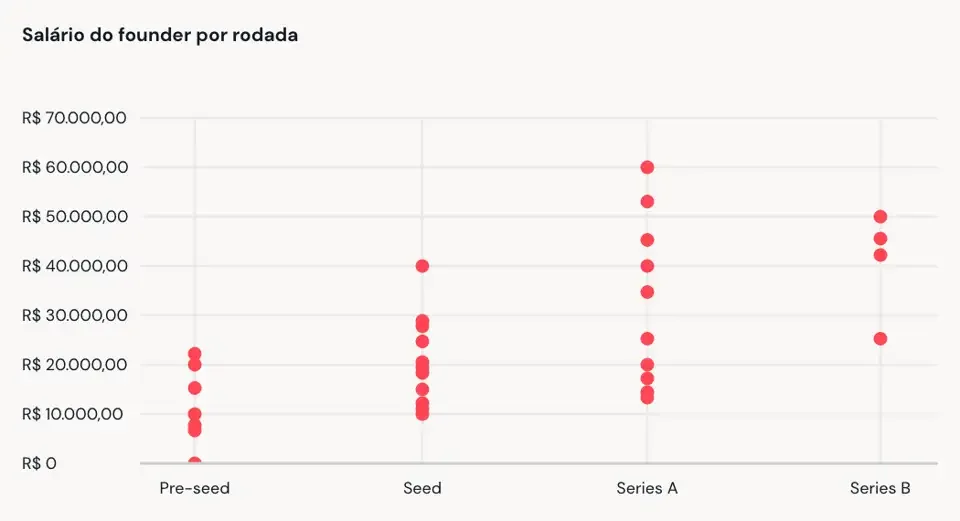
Average and median salaries by stage, and the number of companies at each stage:
| Pre-seed | Seed | Series A | Series B | |
|---|---|---|---|---|
| Number of startups | 14 | 37 | 20 | 5 |
| Average | R$ 11,442.86 | R$ 19,878.63 | R$ 28,200.00 | R$ 42,400.00 |
| Median | R$ 10,000.00 | R$ 20,000.00 | R$ 25,000.00 | R$ 45,000.00 |
Part 2: How does the amount of founder equity affect salary?
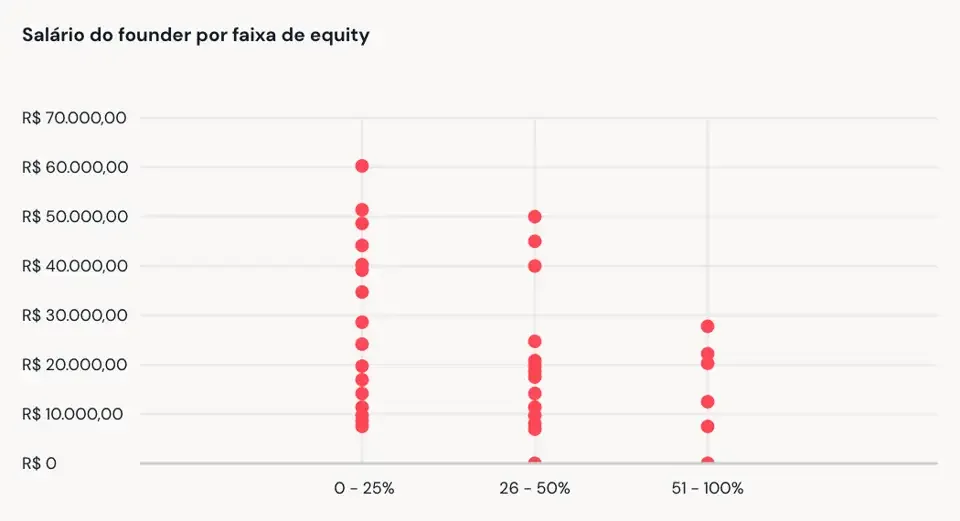
Generally, the more diluted the founder, the more rounds they've raised and the more they pay themselves. As the chart below shows, there is a moderate correlation between lower ownership and higher salary: among founders who hold less than 25% of the company, the average salary is ~R$ 25,000. Among founders who hold between 26% and 50%, the average salary is ~R$ 20,000. Among founders who hold between 51% and 100%, the average salary is ~R$ 16,500.
It's worth noting how founder ownership changes over time. After two funding rounds (seed and Series A), it's common for founders to own <25% of their company (assuming more than 2 founders, with each institutional round diluting founders by 15-25% and additional equity going to early employees). As a compensation benchmark, this analysis shows that the average founder stake at IPO is 9%.
Part 3: What can we relate to founders' age?
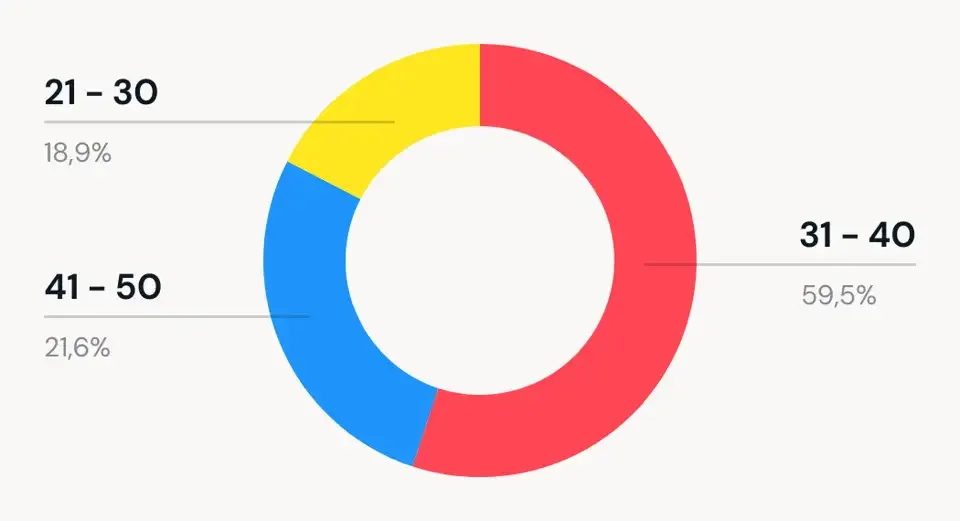
Contrary to the myth of the young founder in their early 20s, most founders in our dataset, 81.1%, were over 30.
When we look at the 3 variables of Age, Company Stage and Compensation, we find that company stage has a much stronger correlation with compensation than age bracket does. Companies at the same stage, regardless of the founder's age, tend to pay relatively similar amounts, and salaries grow steadily as the company reaches later rounds at every age.
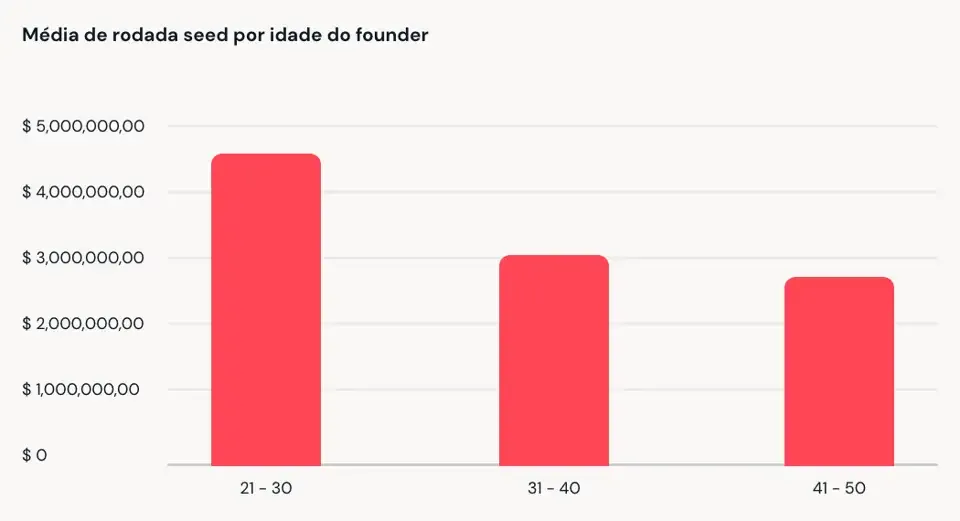
Separately, our dataset showed an unexpected finding: younger founders raised much larger seed rounds last year.
Part 4: What are the most common types of additional compensation and what difference does being paid as PJ or CLT make?
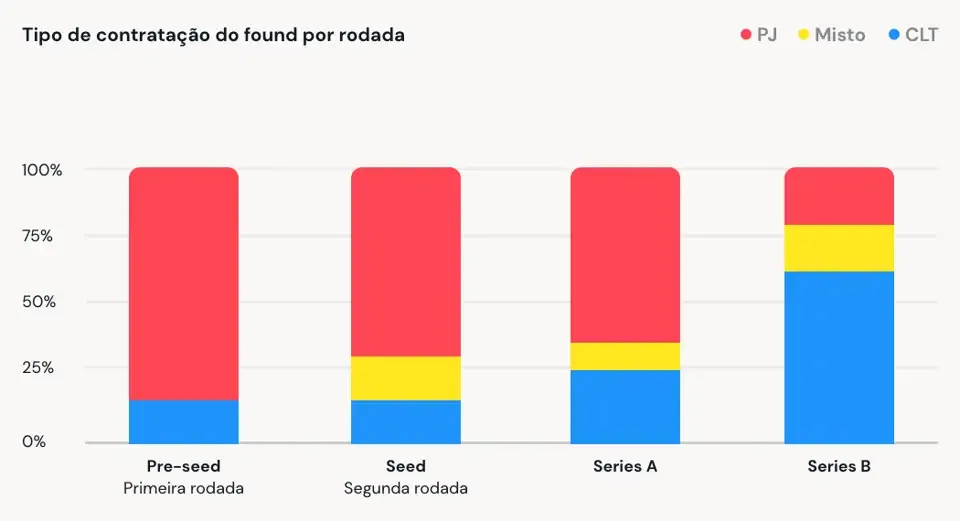
Looking at employment contract type across the whole dataset, 68.9% are paid under the PJ model (independent contractor), 20.3% of founders are employed under the CLT model (formal employment) and the rest report a mixed model. Among PJ contracts, 36.5% get health insurance; among CLT contracts, 60.0% do.
The chart below shows how the PJ and CLT mix changes over time. As we can see, startups from Pre-seed to Series A tend to pay founders under a PJ model, while >50% of Series B founders pay themselves under a CLT model.
Conclusion: Founder compensation is much more art than science
Although cash compensation is moderately correlated with some variables, such as company stage, there is still wide variation in how much founders decide to pay themselves, which depends on countless external variables. We wanted to share this data with the market to show general ranges that help founders think about their salaries, without being prescriptive, given the nuances that shape this decision.