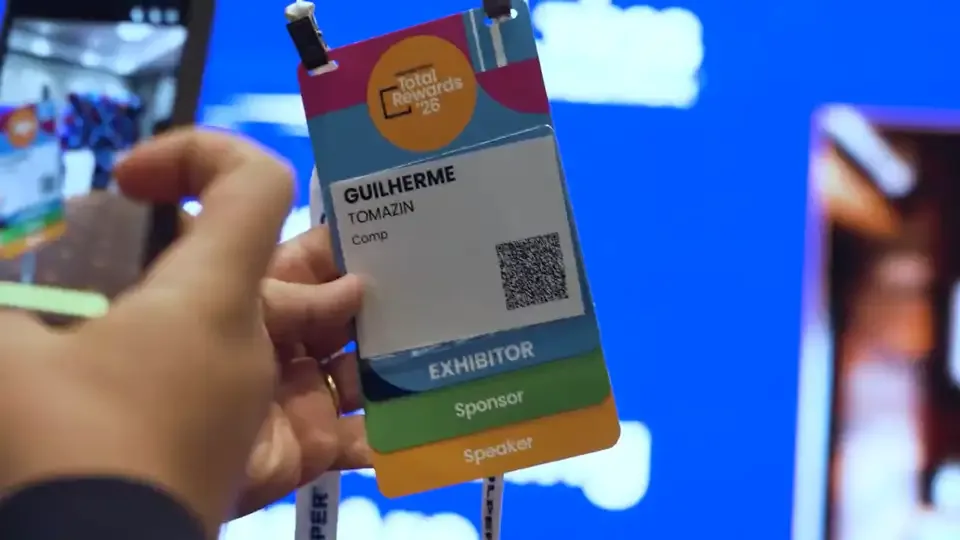
Article
San Antonio, AI Native HR and what came back with me
I came back from San Antonio with a thesis: the gap between vision and execution in Total Rewards is the competitive asset of the next decade. And Brazil is closer to the destination than it usually admits.
 Guilherme Tomazin
Published May 13, 2026
Reflections after three days at Total Rewards’26.
I flew to San Antonio with the quiet expectation every Brazilian executive carries to a global HR event.
I go to absorb, to see where the future is being built, to understand where we're behind.
I came back with a different feeling. It's not that the future wasn't there. It was. The program had more than 150 sessions, and at least a third of them mentioned AI in the title. But the future I saw being discussed on the panels had a specific texture that's worth naming.
That was my macro takeaway from the event. I'll develop it here.
What happened on stage
The opening keynote was by Tom Hiddleston. He didn't talk about compensation. He talked about bravery. "Bravery is integrity under pressure and deployed courage." He presented a four-quadrant framework crossing vision and perceived agency: bravery, victimhood, futility, resignation. And one line stuck: "You can succeed your way into failure."
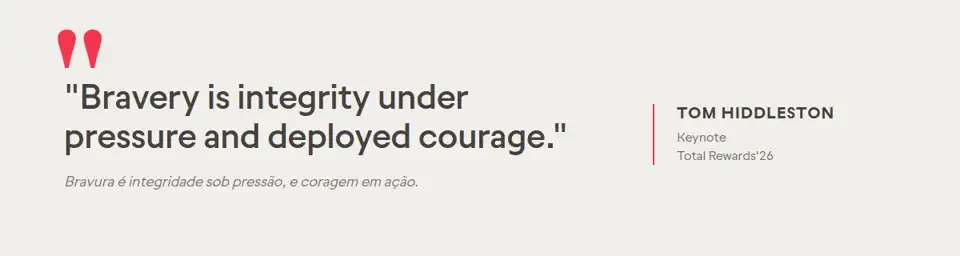
It sounded like executive poetry. But the whole room knew what he was talking about.
Total Rewards is a discipline that has piled up decades of operational success: well-run comp cycles, well-administered surveys, well-maintained compliance. We built the function on a stable premise: data comes in cycles, decisions come after the data, and process organizes it all. That model worked because the speed of the business fit inside it.
The AI era breaks that premise. Data stopped coming in cycles and started coming in a flow. Decisions can no longer wait for the next cycle. Process, which was the discipline's asset, became the discipline's bottleneck. And the courage Hiddleston named on stage, integrity under pressure, describes exactly what the function needs to do now: have the integrity to recognize that what worked for the last twenty years is not what will work for the next five. It's not just changing process, it's changing architecture.
The underlying agenda of the whole event was this: what do we do now that the operational base has become a commodity, and courage has become a prerequisite?
The answer showed up on three fronts.
First front: HR as a business, not as a function.
The session Transforming Total Rewards: From Siloed Administration to Strategic Business Impact opened the topic. It brought a case from an American supermarket chain that didn't staff bakers and butchers for the weekend. A customer walks into the store, can't find what they need, and takes the entire basket to a competitor. The loss wasn't one purchase. It was the purchase occasion. And the problem wasn't operations, it was workforce design.
Casey Webster, from My HR Extension, took this further in HR As A Profit Lever. She showed a turnover formula (departures × average salary × multiplier) and a case where 25 thousand dollars of leadership coaching avoided 540 thousand in annual losses. She was honest enough to say on stage that the multiplier was "feeling, it felt like I was making it up".
I found that line more revealing than she probably realized.
The thesis is right: HR needs to translate people problems into dollars to earn a seat at the table. What becomes clear between the lines is that even the upper bound of the market still calibrates this translation by feel. The bar is lower than we imagine.
And that's exactly the gap AI Native HR closes. Not to make the translation more elegant, but to make it in real time, based on real data that already exists inside the company, inside the decision itself, and not three months after it, in a deck.
Second front: agentic AI as the horizon.
The panel Agentic AI in Action: Transforming Rewards for the Future brought together Radford, Comppport, Google, UW and Stripe. Good lineup. The evolution framework it proposed, Rule-based → Predictive → Generative → Agentic, became the consensus in the room.
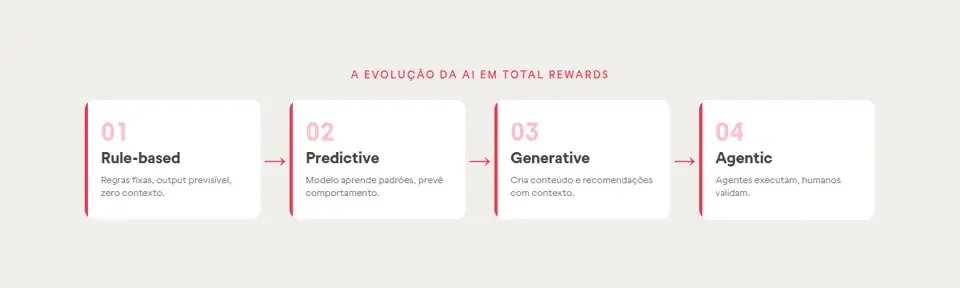
Two lines stood out. "Agents act, humans review." And the panel's non-negotiables: no final pay decision made by AI alone, a complete audit trail, human override always available, a mandatory escalation path.
I agree with every one of them. But there's a detail worth noticing.
For "agents act, humans review" to happen, the agents have to be acting. And the panel's own iceberg made clear that "spreadsheets still running comp cycles". In 2026.
A note here. Spreadsheets running comp cycles is the reality in Brazil too. But the pace of change I see in our market, especially in the slice of tech that has scaled in recent years, is structurally different from what I saw in the room. Maturity has already moved. And Zivo is among the companies pushing this shift with an explicit AI Native HR positioning, not as a module, as a category.
The vision is agreed on. The execution is not.
Deloitte went deeper on this in HR Reimagined in an AI World with Greg Stoskopf and Renzo Tognocchi. They brought two striking numbers: 78% of business leaders increasing AI spending in the next fiscal year, and 39% of core skills changing by 2030. They presented a five-level Maturity Model: Exploring, Experimenting, Establishing, Scaling, Innovating. They ran a live poll in the room.
Most people answered Level 2. That wasn't a criticism of Deloitte, it was a diagnosis of the market, and the market was in the room.
Third front: data architecture as the new infrastructure.
Aon brought Step Into the HR Data Command Center, with Shana Gotlieb. A well-designed conceptual architecture: Data Lake, Transformation Hub, Command Center, Analytics, Config Engine. Cross-cutting insights worth the trip: pharmaceutical workers with consecutive overtime generate 12x more workers comp claims; a diabetic employee working remotely three days a week generates 24% lower medical cost; two mental health sessions correlate with 3x more in-store sales.
Impeccable thesis, big-broker at its best. The opening slide had a disclaimer few people noticed: "capabilities at varying maturity, indicative roadmap, may change, not a commitment." In plain terms: part of what you're seeing here is at different levels of maturity, it's an indicative roadmap, it may change, and it's not a delivery commitment.
It's not a criticism, it's just the state of the art. The market is still selling architecture, and that's honest. But it's a sign of where we are. And that's exactly the space Zivo has been occupying, moving out of the indicative roadmap and delivering architecture in production, with real clients, generating measurable outcomes.
The pattern that emerged
I left the event with three observations that repeated in almost every session I attended.
The first is that the market has converged on the vision. The phrase "HR as a function of judgment, not administration" showed up in at least four different contexts. Nobody argues about the destination anymore. The destination is the same.
The second is that the market has also converged on anxiety. Deloitte ran a second poll asking how the room felt about AI in HR. "Excited" and "anxious" practically tied. Defensive phrases like "we won't replace humans," "human in the loop," "AI argues, doesn't decide" showed up in almost every session. That makes sense. It's nearly impossible to navigate a transition of this magnitude without anxiety. But it's worth noting that defensiveness is built into the market's discourse right now.
The gap between vision and execution is the competitive asset of the next decade.
Whoever is at Level 2 today and wants to get to Level 4 will need something that workshops and maturity models don't deliver. They'll need real operation, in production, with a real client, generating measurable results. And this is where the story gets interesting for us.
What does NOT work
Before talking about what we showed on stage, it's worth naming what doesn't work. Because the event spent three days discussing solutions, and almost nobody stopped to honestly map what HR has already tried and why it's still where it is.
Four paths circulate in the market today.
Point SaaS. Comp software, performance software, engagement software, survey software, people analytics software. Each solves one piece, and together they create fragmented complexity that nobody integrates. They were designed with a control mindset, not a product mindset. Adoption is low because HR has no one to implement them.
Traditional consulting. The Big 4 deliver a very high-quality diagnosis and leave. The knowledge walks out with the consultant. The client is left with a deck and good intentions.
BPO. It has a structural conflict of interest. If the BPO uses AI to become more efficient, it raises its own margin and lowers the client's ticket. It will never tell you it could deliver this for less. The automation stays its secret, not your gain.
In-house specialist. It takes two months to hire and three months to be absorbed by the chaos of day-to-day work. Within six months, the specialist has become just another operator putting out fires.
None of these four paths executes end to end, from strategy to implementation, from implementation to execution. That gap is what defines the new category.
What we took to the stage
Zivo's session took place on the afternoon of the 21st. I brought the Avenue case, a Brazilian fintech that competes for talent in São Paulo and New York at the same time, in competitive, regulated markets where slow compensation decisions are expensive.
I presented two cases. Hiring and recognition. Both already running in production, integrated with Zivo.OS and each flow's systems, operating inside the communication tool the team already uses day to day. The live demo was of hiring, because it's the flow where friction shows up most and where the effect is most immediate.
The operational numbers are already interesting:
- 60% less time between approval and accepted offer
- Comp cycle from 2 months to 2-4 weeks
- 200+ hours a year saved across leadership and HR
- 5% more TA capacity, positions per month
- Three parallel spreadsheets down to zero
But the part that mattered most on stage wasn't efficiency, it was the reframe. The line I used was: we don't fix processes, we fix decisions.
The difference is bigger than it looks. Fixing a process means doing the same work faster. Fixing a decision means changing who decides what, based on which information, at which moment. AI at the center, not at the edges. Not as an automation layer on top of a tired manual process, but as the piece that processes all the data the company already has (and almost never manages to cross-reference in time) to return a decision proposal inside the context where the decision needs to happen.
In practice, this changes three things.
Mental bandwidth. Managers and HR stop spending attention building spreadsheets, checking data, copying information from one system to another. The energy goes back to where it matters: judgment.
Friction between leadership and HR. The relationship stops being about process (waiting for data, waiting for approval, waiting for an answer) and becomes about decisions. Whoever needs to decide, decides. Whoever needs to validate, validates. Nobody builds anything from scratch.
Speed and accuracy. Decisions stop being built in a cycle and start being made in a flow. It's not just faster, it's better grounded. Because the agent cross-references, in seconds, far more variables than a human can cross by hand in a full day, and hands it back as a starting point, not as a task.
To be more precise: we don't build a decision tool. We build the ecosystem where the decision happens, gets validated, gets executed and becomes learning for the next one.
AI Native HR is a category, not a feature. And that's why it's hard to copy as a module: the shift isn't technological, it's architectural. The company that understands this first will build a human capital advantage that the next decade won't be able to replicate by looking from the outside.
The outcomes that matter
The second part of the presentation moved the focus away from operational metrics (cycle time, hours saved, spreadsheets eliminated) and onto three outcome blocks that every Zivo delivery is committed to moving.
Efficiency. How much effort HR stops spending on repetitive tasks and frees up for judgment work. A well-calibrated Zivo ratio, an accelerated comp cycle, HR headcount not scaling linearly with company headcount.
Experience. How much friction managers and employees shed at decision moments. Approval that fits in the day's conversation, in the tool where the team already lives. Recognition that goes out in the moment. An offer that reaches the candidate before the counteroffer.
Talent Density. The company's ability to make good decisions about people. This is where the indicators the market isn't yet used to measuring come in: % of Key Talent in Key Positions, Buy vs Develop Index, end-to-end Lost-to-Replaced Cost, Recognition Effectiveness compared between recognized and unrecognized high performers, Revenue per Headcount.
These three blocks aren't operations KPIs but human capital KPIs, and they only become available when the decision infrastructure is in place.
At the end of the presentation, a TA leader from Mondelez took a photo of the slides to send to her team. A comp leader from an American big tech asked to understand the Talent Density concept better, a term that has become common for us in Brazil. A Deloitte speaker answered an audience question about "how to get started in practice" by describing, without knowing it, a version of the method we already use. It wasn't chance, it was a reflection of where the event was.
The reframe on Brazil
I want to be careful here. I'm not being cheaply nationalistic, and I'm not flipping to the opposite side of the "stray dog" inferiority complex.
But the observation deserves to be made: Brazilian tech companies that grew over the last 15 years operated under structurally different conditions than American ones.
- Scarcer talent per capita.
- More expensive capital.
- More ambiguous regulation.
- More volatile currency.
Those who survived in this context developed a specific muscle: design under constraint. It's a different kind of skill. Not better or worse. Different. And it becomes an advantage in a world where TR infrastructure needs to be reinvented from scratch, with AI at the center, instead of added as a layer on top of legacy structure.
There's more. Those who operated in a chaotic environment learned to optimize a different variable: speed of learning.
It's not a detail. In a market where nobody yet knows the right way to do things, more learning becomes more judgment. More judgment becomes more right decisions. More right decisions become more results. It's an objective function, not a culture slogan.
Zivo was born in this context. Not as an AI overlay on a legacy HRIS, but as AI Native from day 1: Zivo.OS as the intelligence engine, the client's communication tool as the default UX, agents executing and humans validating.
Avenue is not the exception, it's the template.
The thesis I brought back
And the architecture has a specific shape. It's worth naming what's behind the product.
Three layers and a loop.
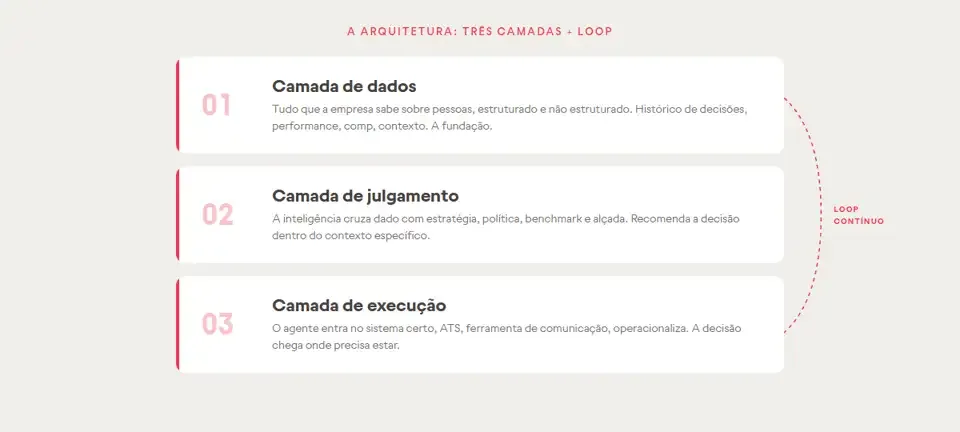
Data layer. Everything the company knows about people, structured and unstructured. Decision history, performance, comp, context, conversations. It's the foundation. Nothing happens without it.
Judgment layer. Where intelligence crosses data with strategy, policy, benchmarks, approval authority. It recommends the decision. It's not AI laid over a spreadsheet, it's AI generating a decision proposal inside the client's specific context.
Execution layer. Where the agent enters the right system (ATS, internal tool, the team's communication tool) and operationalizes. No extra button. No new screen. The decision leaves whoever decides and arrives where it needs to be, in the format it needs to be in.
The loop. Every validated decision becomes evidence for the next. When the human rejects, they explain why. The agent learns. The cycle closes. The system gets progressively more aligned with the company's judgment, not the market's average judgment.
For someone at Level 2, this sounds radical. For someone who's operated this way for years, it sounds obvious.
The difference between the two groups isn't technical capability, it's starting point. And Brazil's starting point, at least in the slice of Brazilian tech that has scaled in recent years, is closer to the second group than we usually admit.
That was the thesis that came back with me from San Antonio. It didn't come from my presentation, it came from what I saw in the others.
Closing
I ended the presentation with a line from Einstein:
A mind that opens to a new idea never returns to its original size.
I used it as a provocation for the audience, but it applies back home too. Global events exist for this: not to confirm where we're behind, but to calibrate where we are. And occasionally, not always, but occasionally, to realize that the place we started from was already the place the market is heading.
San Antonio was one of those moments. I came back with a more open mind, and with more conviction about what we've been building at Zivo.
The shift has already started, and the stage showed that it's less a question of time and more a question of origin.
The live demo I presented at Total Rewards’26 is available below in interactive format. It's the same end-to-end hiring flow we run today at Avenue, recreated for browsing. It's better to see it working than to read it described.
Click here to access the Avenue live demo →
Guilherme Tomazin Sr HR Executive · Zivo