Article
SOMA 2026: three accents, one question
Three panels, three framings and one question nobody agreed to ask. A reconstruction of SOMA 2026 and what it says about the future of HR.
 Pedro Bobrow
Published May 20, 2026
What I heard in the three panels at Brazil's main Total Rewards event, and why they all orbited the same question from different angles.
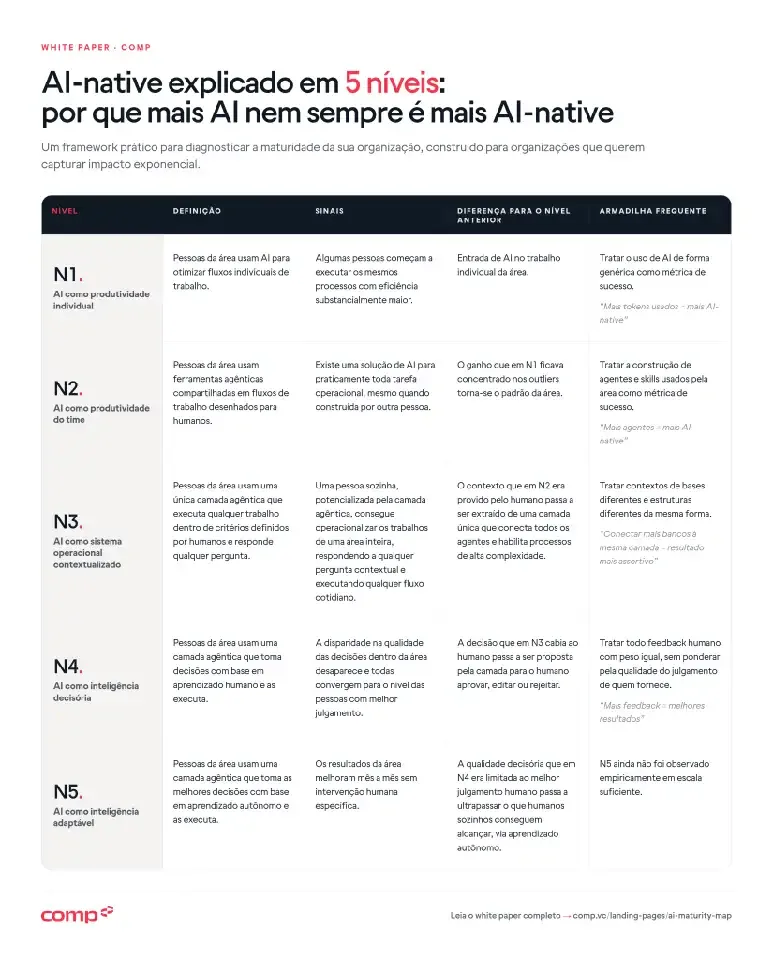
On Monday afternoon, May 18, I published a white paper that Zivo has been developing for a few months on organizational maturity in AI adoption. Five levels (L1 to L5), with criteria and examples for each. We figured that the next day it could serve as backdrop for a few behind-the-scenes conversations at SOMA.
Early Tuesday afternoon, in the day's second panel, I heard Rodrigo Souto (HR Director at IBM Brazil) recommend the material live, on stage, next to Alessandro Bonorino (Partner and CHRO at XP) and Emerson Martins (Head of HR Brazil at Google). The document entered the stage conversation as if it were already part of the shared vocabulary. It had been out for barely 24 hours.
It's quite provocative, especially when you get to level 5.
Rodrigo Souto, HR Director IBM Brazil, on the white paper
SOMA is co-hosted by Zivo, Pipo Saúde and Caju, and remains the main senior forum for Total Rewards discussions in Brazil. The first edition, two years ago, was an experiment. This was the third, with more than 500 senior People executives. The jump was striking.
I went to SOMA expecting to hear three different conversations and ended up finding, more or less, a single one in three “accents.” The common thread across the panels wasn't planned. They all attacked the same question from a different angle: what does AI do to work, and what should the People function do about it?
Zivo's panel: Org Design in the age of AI
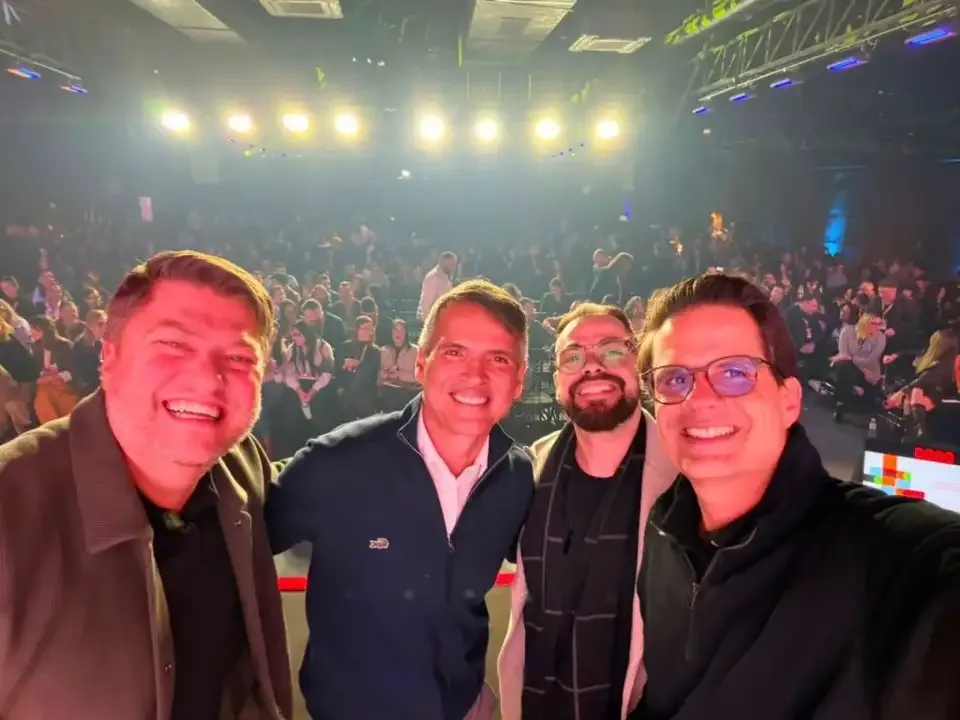
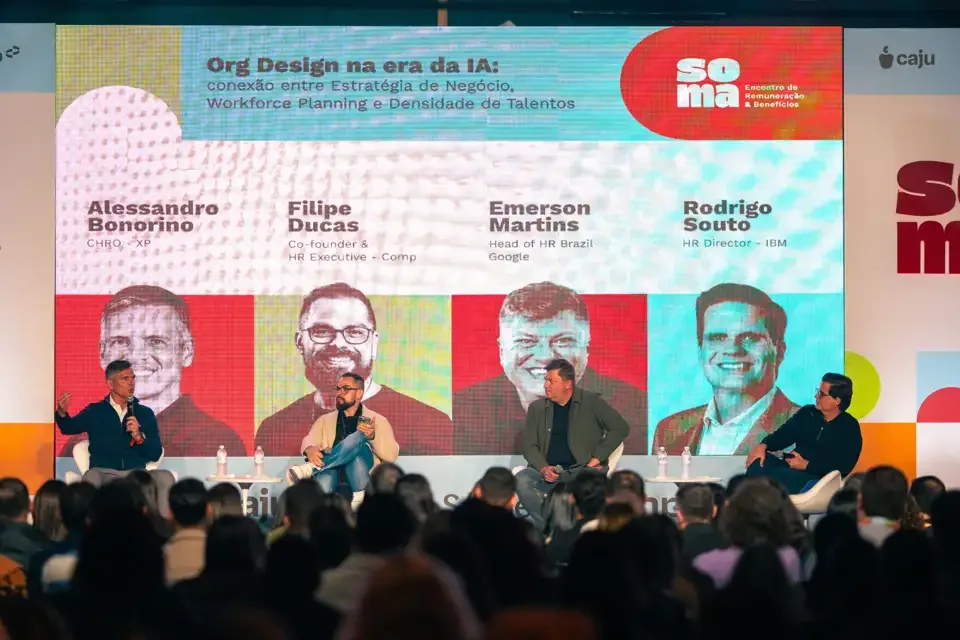
This year's Zivo panel, “Org Design in the age of AI: connecting Business Strategy, Workforce Planning and Talent Density,” was moderated by Ducas, my Co-Founder at Zivo. The panelists are people making very big decisions on the question at hand, but in very different contexts:
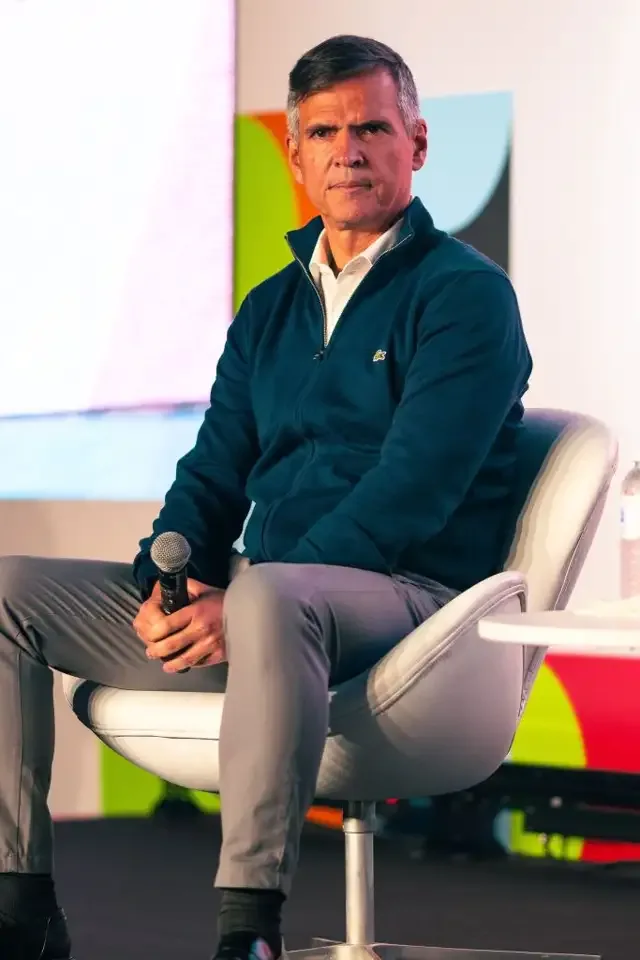
- Alessandro Bonorino, Partner and CHRO at XP, with 25 years leading HR in multinationals, who led technology + people for seven years at BRF.
- Rodrigo Souto, HR Director at IBM Brazil, with almost 30 years at a company that reinvents itself in long cycles (from hardware to cloud, and now to quantum).
- Emerson Martins, Head of HR Brazil at Google, coming from more than a decade of regional HR leadership at Thomson Reuters.
I loved that the first question Ducas asked on the panel was blunt (and set the direction of the whole talk): “Bonorino, if you cut an entire layer of management at XP, would the customer miss it?”
Bonorino's answer opened the conversation: “If you're guaranteeing process and procedure, you can think about cutting. If it's going to affect business impact, then no. It's estimated that 1% of roles generate 80% of the results.” The statistic he cited has been circling the Org Design debate for a while. Pareto on steroids. Regardless of how literal the number is, the shape of the curve is the part that matters: organizations are deeply uneven in where value concentrates. The strategic decision becomes about that concentration, not about headcount.
1% of roles generate 80% of the results.
Alessandro Bonorino, Partner and CHRO XP
Rodrigo brought the scale angle. IBM has been in Brazil for more than 100 years and has reorganized itself many times. He described a job redesign process that should take two years: “we saw a role that has 9,000 steps.” He presented the four pillars of IBM's AI strategy (agents, data, automation, governance) and pointed to where he sees Brazil moving slowest: “we want to put AI in, but we don't have the governance system, we don't have the control system, return on investment.” But what stayed with me most from Rodrigo was the generalization he made about what's coming: “we won't just lead humans. We'll lead humans and AI. There will be hiring of AI, performance management of AI, there will be Drift, and eventually firing the AI.” It's a new vocabulary, spoken by an HR director of a century-old company, on the stage of the country's main event in the field. This isn't theory anymore.
We won't just lead humans. We'll lead humans and AI.
Rodrigo Souto, HR Director at IBM Brazil
Emerson took the density angle. “AI isn't technology, it's already an organizational skill.” The recent news that Google optimized 35% of its management layer, which circulated in the market as a “cut,” was actually a rebalancing. “Where we're investing most today is in training middle managers, precisely so you can transform operational managers and bring in these new competencies, these new skills, so these folks can be more strategic.” The most concrete piece of what he described: Google's HR operates as a business unit, with business strategy, product areas and engineers thinking about AI solutions for HR itself. Its compensation plan hands the manager “a whole logic behind it, including a recommended script for giving the salary increase feedback.” It just doesn't decide. The final decision stays human.
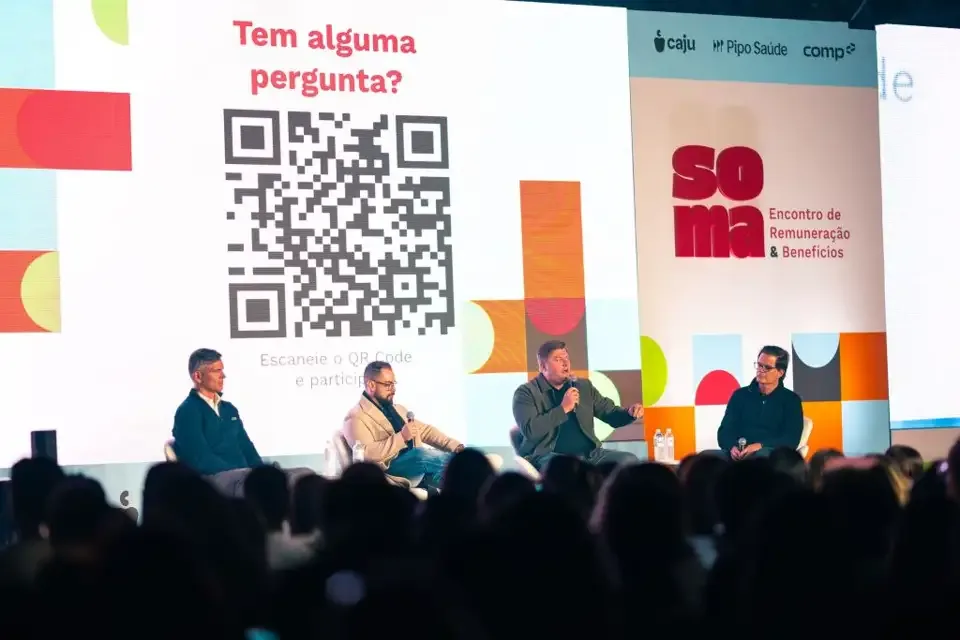
AI isn't technology, it's already an organizational skill.
Emerson Martins, Head of HR Brazil at Google
For those who read the white paper What it means to be AI-native: 5 levels of organizational maturity in AI adoption, what these three describe are organizations at different levels of the map. But what matters, from an operating-plan point of view, isn't which level each one is at. It's what the target level is for each area, and which building blocks of that level need to start being assembled now. That's the question that organizes action. The rest is discussion.
Pipo's panel: the C-level view
Aline Esteves, Partner and CHRO at Monashees, moderated the final panel, with three CEOs: Manoela Mitchell (Pipo), Gabriel Alves (Rede Decisão) and Pedro Vasconcellos (Woba). It was the panel that spoke most directly to what Zivo is building.
Pedro Vasconcellos opened the most concrete part of the conversation. He talked about candidates applying to Woba who ask, during the process, how big a token budget they'll get, and he translated for anyone who had never thought about it: “what she's asking is how big my team is, in the new format.” He talked about org charts with agents drawn next to people. He talked about six new roles that had to be named at Woba to run the organization as AI-native: builders, operators, engineers, champions, evangelists, guardians. And, in the middle of that description, he said that “Zivo is a great ally of ours, it brings superpowers to our HR team so we can do this at scale.” I'm noting this because, said live by a CEO who knows what he's describing, it's worth more than any release we could publish.
Zivo is a great ally of ours
Pedro Vasconcellos, CEO of Woba
Gabriel Alves, of Rede Decisão (24 campuses, 14,000 students, several acquisitions), raised the point that stalls the most conversations today: the lack of a common language. “When Pedro says ‘token,’ he's already put a clear metric in the CFO's head. It has to go in the budget. You have to measure the return on it. When marketing says CAC, every CFO has been trained for that. HR still doesn't have that lingua franca.” In my experience, it was a surgical diagnosis of why so many HR conversations with the C-level stall. It's less about CFO resistance and more about vocabulary incompatibility between the two sides.
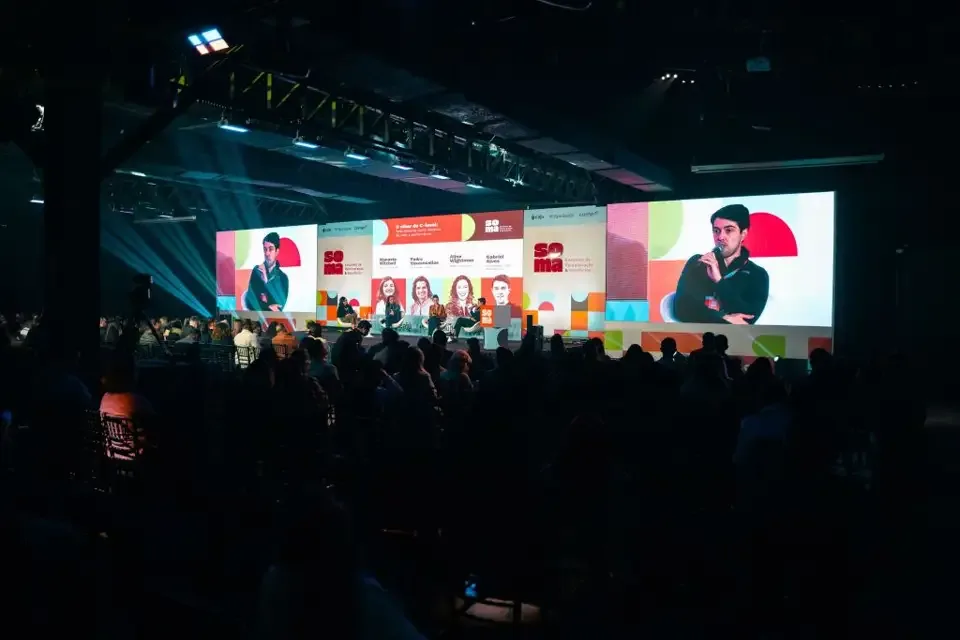
Manoela Mitchell, founder and CEO of Pipo, closed with the boldest contribution of the day. She contrasted two operating models for HR. Coordination HR, which guarantees homogeneity: the same performance yardstick, the same benefits policy, the same leveling. And effervescence HR, which deliberately accepts entropy, at the stage where the organization is discovering the new way of working. “Take the handbrake off the car and let it roll,” she said. “There will be a lot of agents, a lot of people doing things, there will be token spend, things will get a bit out of control, which is very hard because we were taught to be controlling professionals. We have to let go of that trait a little.”
Is HR coordination or is HR effervescence?
Manoela Mitchell, founder and CEO of Pipo Saúde
She added that this letting go depends on internal politics: the CHRO needs to convince the CEO to also be an agent of entropy. “You want to have 15 reports? Go ahead.” The line wraps up a specific analysis of what separates old HR from what's coming now.
I've been running this question inside Zivo. The formulation I've been using, which speaks to what Mano put forward, goes more toward understanding what holds the system together when coordination gives way. For an organization to accept entropy without turning into chaos, it needs a technical and operational layer that enables fast testing, light governance, a frequent demo ritual and visibility into what's being built. Whoever operates AI-native, in the end, runs the company's work more like a Product Manager than like a guardian of process.
Caju's panel: the practice
Lucas Fernandes, Chief People Officer at Caju, moderated the opening panel, with Taís Garcia (HR director at Britânia), César Luján (Director of Total Rewards LATAM at McCain Foods) and Danilo Penteado (Head of Compensation at Olist). It was a panel more anchored in the factory floor and real operations, and it's where the specific hook that ties the whole day together came from.
Taís described the brutal reality of running a factory in Joinville with a 2.7% unemployment rate. A complete compensation restructuring, a redesign of the factory environment, lower turnover. And, in the middle of the presentation, she mentioned a recent hackathon she ran with Britânia's directors and executives focused on AI applied to production. It's a specific signal: a 70-year-old industrial company, a factory operation in a city with a labor shortage, and HR leading the company's AI experimentation.
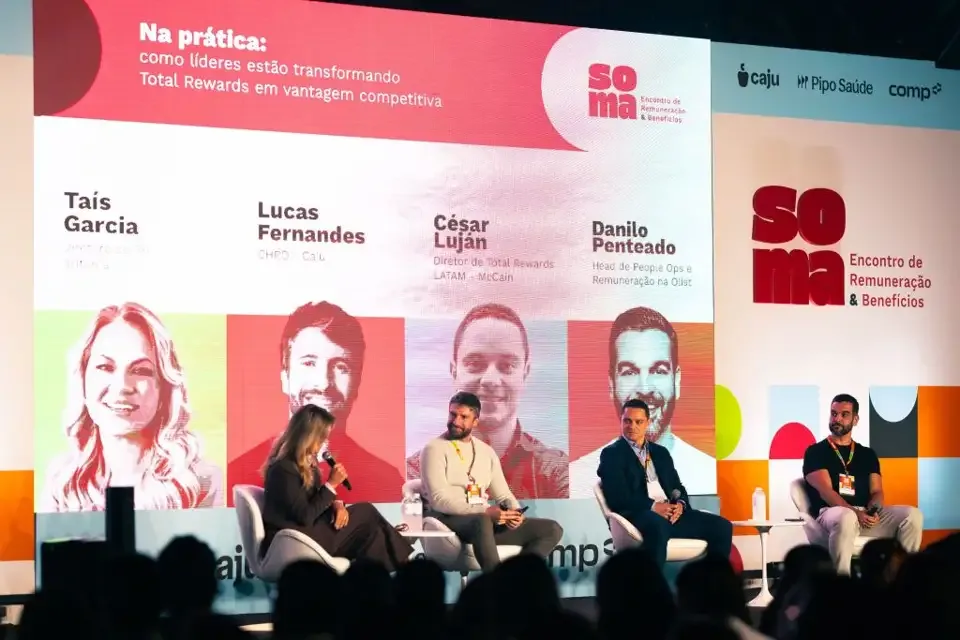
César described McCain's full integration of Forno de Minas, in 2023. They rethought the entire compensation architecture before integrating, instead of pushing the McCain model on top of Forno. “If the methodology that brought us here was the one that would take us to 2030, if the salary ranges, the peer groups, were what would take us there…” The decision was to change everything, for all of LATAM, at the same time.
But it was Danilo who brought the hook that kept pulsing until the last panel. He described the following case: a candidate with a Harvard background discussing an offer asked the recruiter for a salary five times higher. His justification: he delivered the work of an entire team, with his own portfolio of agents. He presented a dossier describing what he did alone. “How are we going to retain a person like that? How are we going to hire a person like that?” I see it as the most concrete question of the whole event.
How are we going to retain a person like that? How are we going to hire a person like that?
Danilo Penteado, Head of Compensation at Olist
Elena Verna, a Growth operator at Lovable, has been using the following term for this profile: HI-C, or High-Impact Individual Contributor. Her definition: an IC who can deliver an end-to-end project that produces business value, alone. Usually a former leader (manager, director, VP) who went back to doing the work because, with AI, doing the work pays well again. She says being an IC has become a career flex. Danilo described the same profile from the employer's perspective. The two readings fit together.
Coming back to Danilo's questions, I've also been thinking about how the productive team is changing. Coinbase, Block, Amazon and Microsoft are examples of companies publicly carrying out this transition (with pods of 1 to 3 people and span of control doubling), where the HI-C stops being a one-off exception to be paid for and becomes part of the organization's basic unit of capacity. The two questions, how to pay and how to redesign, go together.
What changes in the seat
I'm a co-founder of Zivo and, not long ago, I officially took the CHRO seat. I accepted for a practical reason: Zivo has passed 50 people, and past that size the function becomes even more critical. I also accepted because I've been operating inside this question (how the company's work changes when AI takes over part of it) and wanted to make that explicit.
The question driving the work being done inside Zivo is the same one the white paper poses: what is the target level for each area and which building blocks of that level need to start being assembled now. For People, the answer is still being written, with mistakes and adjustments. But the agenda is set! Where the bottleneck of the work sits when testing stops costing people's time. How to govern without becoming a brake. What makes one team's work become another team's repertoire, instead of dying as a prototype. Each of them has more than one right answer. I'm in the middle of finding out which ones apply to us at Zivo.
What changes in the seat of the CHRO of an AI-native company, in the end, is the kind of risk she accepts to carry. Before, the risk was variance: keeping the system homogeneous. Now, the risk is immobility: not letting the system evolve fast enough. Both still exist, but, as I see it, the weight between them has already flipped.
Excited for the next ones!
It was a SOMA that will be talked about across many channels in the coming days, and it renews the case for a 4th edition. The takeaway I drew from it fit in two lines. The next decade of HR will be decided by how fast each organization learns to operate AI inside itself. And the ones this decade rewards aren't the HR teams that coordinate the most, but the ones that distribute the most capacity.
For those who read this far without having been with us at the event: all the SOMA panels are available in full here. The white paper on the five levels of AI adoption maturity is on our site. And the door to our calendar is open.
For those who were there: it was a great day. Thank you for being with us!

Pedro Bobrow Co-Founder & CHRO · Zivo